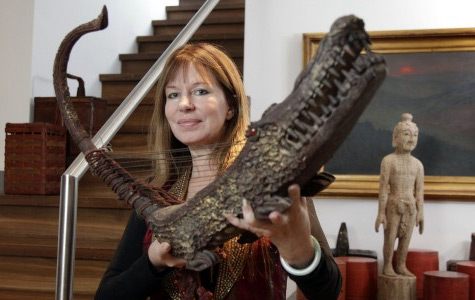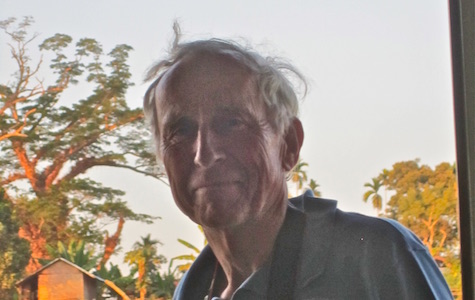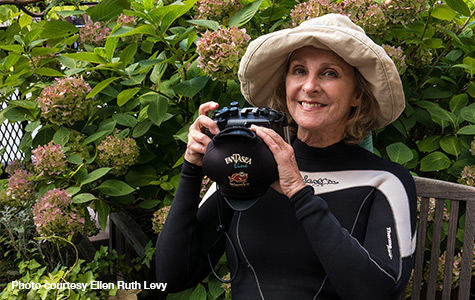
This not for profit venture serves to promote exploration through recognition of significant expeditions and discoveries. It also curates special exhibits featuring feats and historical achievements. Charleville Castle serves both as the museum's exhibition space as well as its global expedition base for launching new expedition projects
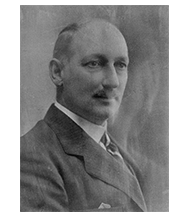 Once the home of Colonel Charles Kenneth Howard-Bury, notable as an explorer and amateur botanist in the Himalayas. Colonel Howard-Bury, was appointed leader of the first expedition which set out to climb Mount Everest in 1920-1921. While Colonel Howard-Bury was not himself actively involved as a climber, George Mallory and other members of the expedition team reached some 23,000 feet without benefit of oxygen cylinders or other more recent sophistications in equipment.
This expedition, which received an enormous public following, effectively provided survey information invaluable to subsequent expeditions and established the North Col route as the route of choice for several early attempts on Everest.
The surname Howard-Bury is reflected in the latin name of a plant brought back from the Himalaya region by the Colonel. A room in the Royal Geographical Society in London is named in honour of Colonel Howard-Bury.
The patron of The Explorers Museum is Sir Ranulph Fiennes.
New Exhibition
There’s a certain moment when you step into a museum and realize you’re not really “looking at exhibits” anymore — you’re inside something. That’s roughly the direction this new exhibition at The Explorers Museum HQ is heading. The museum has always leaned into real exploration stories, but this time it’s less about reading plaques and more about reacting, touching, and getting slightly disoriented in a good way.
The project comes together with Lumotion Studio, whose work tends to move beyond passive display. They started in animation but now Lumotion Studio makes interactive environments installations where the visitor becomes part of the narrative instead of just watching it happen.
What that means in practice here is not one big “wow room,” but a sequence of spaces that feel a bit uneven on purpose. One room leans heavily on projection mapping, another is quieter, almost minimal, where sensors pick up small movements and respond in ways you don’t immediately understand.
It’s not always obvious what you’re supposed to do. That’s part of it. If you prefer clear instructions — press button, get result — you might feel slightly lost for the first ten minutes. But once you stop trying to “solve” it, the experience starts working better.
The museum itself gives this project a different kind of weight. The Explorers Museum HQ isn’t just another venue rotating exhibitions; it’s built around the idea of exploration as an ongoing process, not a finished story. The whole place exists to highlight expeditions, discoveries, and the people behind them, while also acting as a base for new exploration projects.
That mission — explore, discover, share, preserve, sustain — sounds broad, and it is. But here it’s interpreted in a more tactile way. Instead of presenting a historic expedition as a fixed narrative, the exhibition sort of reconstructs the uncertainty of it.
There’s a segment, for example, where environmental data shifts in real time based on visitor movement. It’s not scientifically precise, and that’s the trade-off, but it gives you a hint of instability: how conditions change, how decisions get messy, how exploration rarely moves in a straight line.
You can see Lumotion’s influence pretty clearly in those moments. Their approach is about blending physical space with digital layers so the story continues only when someone interacts with it. It’s less “watch this story” and more “complete it by being here.”
The exhibition doesn’t try to overwhelm every second. There are pauses. Dead zones, almost. A corridor where nothing reacts to you at all, which feels oddly intentional after a series of responsive environments. It resets your expectations a bit.
Also, it doesn’t completely abandon traditional content. There are still artifacts and references to real expeditions, some tied back to the museum’s historical roots, including early Himalayan exploration stories connected to figures like Howard-Bury. But they’re integrated differently, not just displayed.
So if you’re visiting and expecting a typical museum walkthrough, you’ll probably need to adjust slightly. It’s less linear, less explanatory. But if you’re open to wandering through something that behaves more like a system than an exhibit, it’s worth the time.
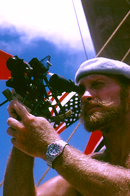
The Explorers Museum is pleased to announce that Captain Norman Baker, world renowned explorer, and celestial navigator for the Thor Heyerdahl Ra, Ra II and Tigris expeditions is this year's recipient of TEM's Exploration Achievement Award. For information on the gala in his honor please inquire [email protected]
The board of directors of the Explorers Museum represent a wealth of experience in the field of exploration, heritage, digital expertise and the museum sector.
Charleville Castle, Ireland
Charleville Castle, Ireland
Charleville Castle
Tullamore
Co. Offaly
Ireland
EU.
[email protected]
Latitude : 53 degrees 15' 39.37 N
Longitude: 7 degrees 31' 40.49" W
View on Google Maps